



· Yogesh Khedar· News· 3 min read
Selected for the Drone Swarm Challenge
Autrik has been selected for a national drone swarm challenge — putting the multi-vehicle heart of AutrikOS to the test in competition conditions.
Some news we are proud of: Autrik has been selected to compete in the drone swarm challenge, a competitive programme in which selected teams demonstrate coordinated multi-drone autonomy under real competition conditions.
What we will demonstrate
The heart of the challenge is what it sounds like: several aircraft operating as one coordinated system. Shared world state, live deconfliction between our own aircraft, and autonomy that holds up outside a lab, on a day with wind.
We are building on the same AutrikOS foundations our customers fly every day rather than a competition-only stack. The fleet layer that already runs mixed fleets of docks, aircraft, rovers and boats. The remote operations centre that puts every aircraft on one map with one operator watching. The onboard client that runs on each aircraft’s companion computer, so a swarm member is a device like any other, with its own health, its own log and its own link budget.
What is new for the challenge sits above that: a shared world model that every aircraft publishes into and reads from, formation and task allocation that run on the ground station and are re-planned when an aircraft drops out, and a lidar tracker on the ground that watches the arena so the swarm’s own position reports can be checked against an independent source.
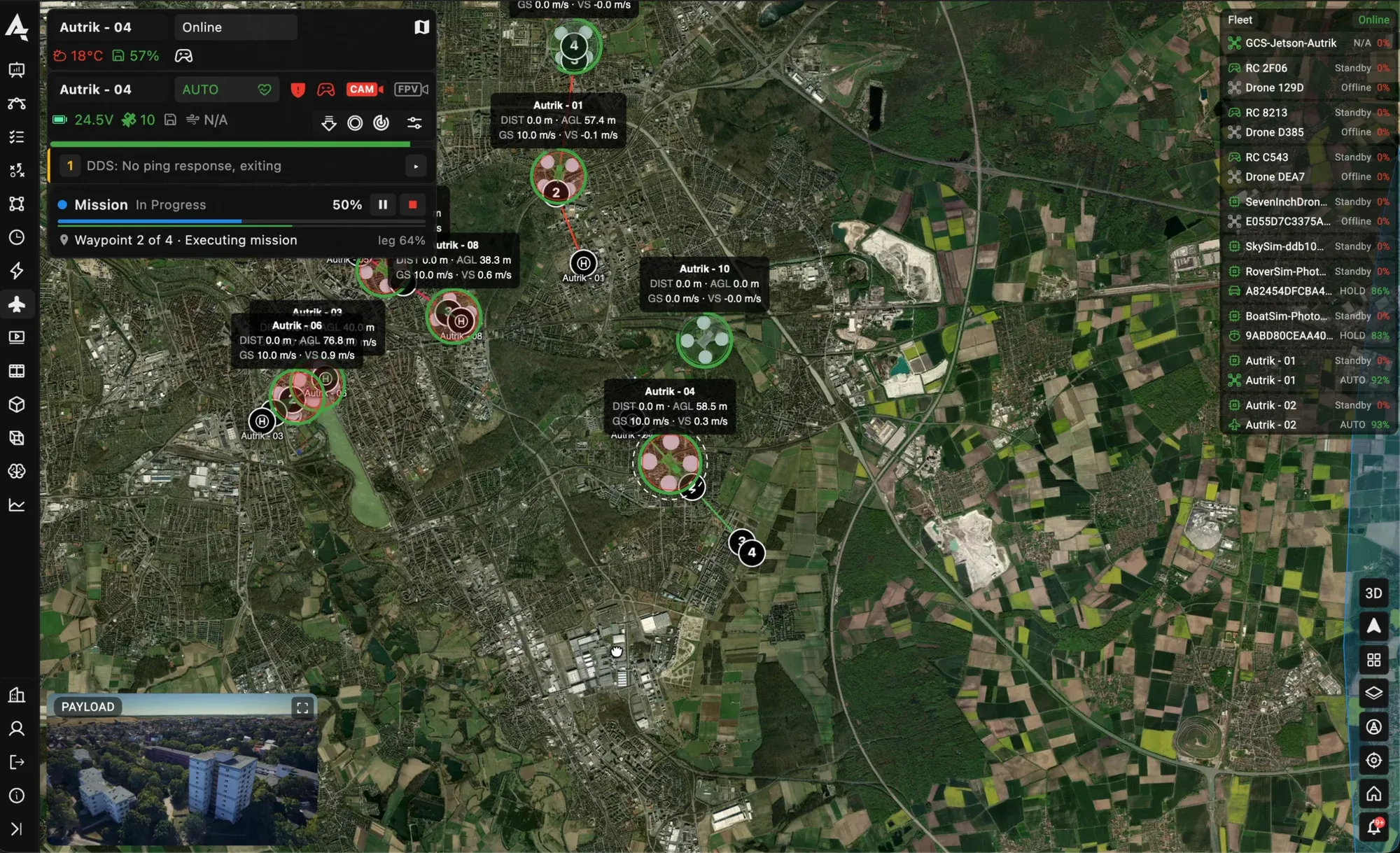
Several aircraft on one live map in the console.
Why it matters
Swarm operations are the extreme case of multi-drone operations. Everything that is merely hard with three aircraft, deconfliction, link capacity, operator attention, must be solved by construction with many. Competing forces the platform to prove exactly the properties we claim for it: one operator, many vehicles, one operational picture, and a failure of one aircraft that the rest of the fleet absorbs.
It also forces honesty. A competition has a jury, a clock and a wind forecast. The things that work in the simulator and not on the field get found on the field.
Selection alone, after technical review against strong teams, is validation we gladly take.
How we prepare
In simulation first. The swarm flies in the same console as everything else, with simulated aircraft standing in for the real ones, so the formation logic, the dropout handling and the operator’s view are rehearsed before a battery is charged. Then on the arena, one aircraft at a time, then three, then all of them, with every flight’s log kept and every anomaly written down, in the spirit of our failure-analysis culture.
Follow along
We will publish what we learn, the engineering and the failures included. The newsletter is the best place to follow the campaign, and the background on how show swarms do it is in How Drone Light Shows Actually Work.
Curious what swarm-grade coordination could do for your fleet? Talk to us.