



· Yogesh Khedar· Engineering· 4 min read
What Does Cybersecure Actually Mean?
Security is a posture, not a property. The components it decomposes into, where we stand on each, and what certifications do and do not attest.
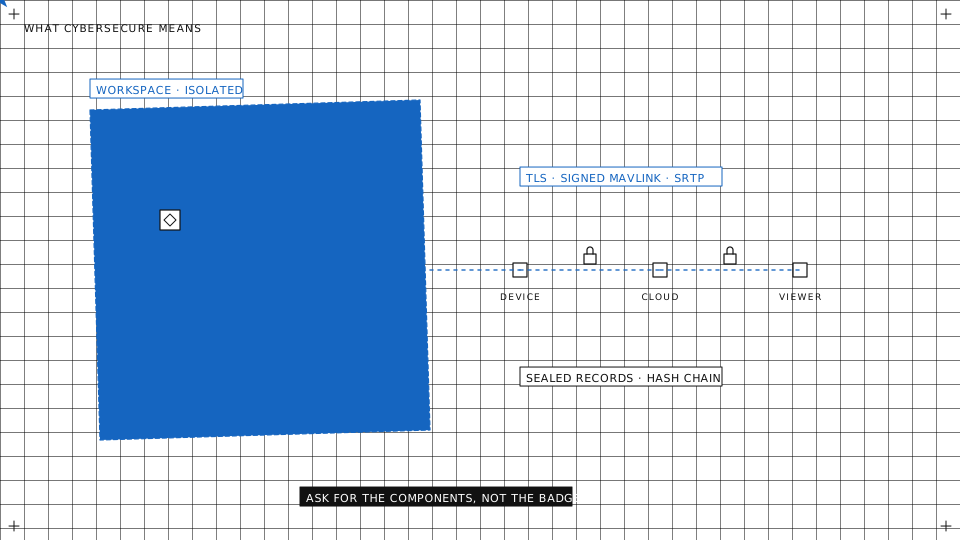
Vendors, including ourselves, get asked whether their system is cybersecure, as if it were a property, like a colour. It is not. Security is a posture against a threat model, and any vendor answering with an unqualified yes has just failed the first test.
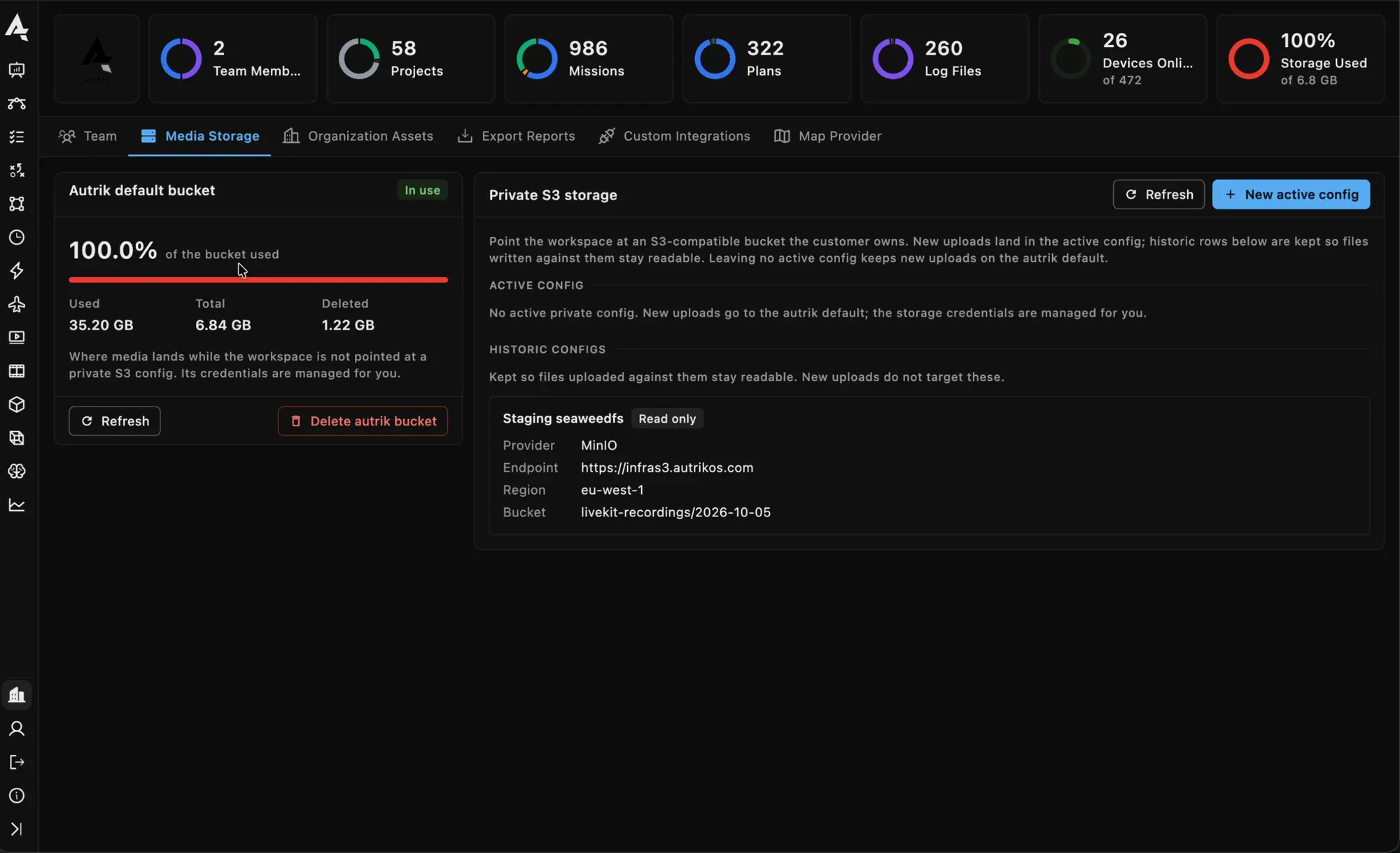
Media storage: the workspace bucket and a private S3 bucket of the customer’s own.
The components that actually matter
Cybersecure decomposes into parts you can inspect. Here they are, with where AutrikOS stands on each, in writing.
- Link encryption. Every hop from the aircraft to the browser, not just the web front end. The aircraft’s link to the platform is TLS; MAVLink commands to the aircraft are signed; video travels over encrypted real-time transport to the viewer. How the links are built.
- Identity and access. Who may command an aircraft, see a stream, export data, enforced by roles rather than habit: admin, operator, viewer, and partner keys with a scope and an expiry for other systems. Every workspace is isolated from every other on every service.
- The update path. Releases go out as a train, staged on a dev stack first and gated by an automated suite against the real services. The onboard client and the apps carry a version the fleet page shows, so an old one is visible.
- Data residency. Where data physically lives and under whose law. Our cloud is hosted in the EU; the same software runs in your cloud, on your servers, or offline on one laptop at the site. Flights, logs, media and records export in open formats.
- Records you can check. Flight records are sealed with a hash chain per workspace, so a record that was changed after the fact says so. Logs can be put on hold so a deletion is refused while a case is open.
- Supply chain. Knowing what code and hardware you ship and where it came from. We build our own onboard client and our own cloud services; the dependencies are listed, the DJI parts are DJI’s, and we say which is which.
- Operational practice. Key rotation, logging, incident response. The part no product can sell you, and the part an auditor asks about first.
We publish where we stand on each and, more honestly, which threat models we do not cover. A customer with a questionnaire gets written answers, and where a control is not in place yet, we say so.
Certifications, decoded
A certification attests that an auditor examined a defined scope at a defined moment. ISO 27001 and SOC 2 class marks are meaningful. Our hosting runs in ISO 27001 certified data centres, and that is the data centre’s certificate, not ours; we have an information security management system of our own and a self-assessment against NIS2, and we say exactly that rather than borrowing the badge.
The crucial question is point-in-time against continuous: was this audited once for the certificate, or is compliance monitored as an ongoing state? Ask vendors that question and watch the answer carefully. A certificate from two years ago describes a system that has shipped fifty releases since.
What buyers should ask
Not “are you secure?” but:
- What is your threat model, and what is explicitly out of it?
- How is the link from the aircraft encrypted, and who holds the keys?
- Where does our data live, and what leaves that place?
- How do updates reach the aircraft and the cloud, and who can push one?
- Can our workspace see another customer’s data under any failure?
- What happened during your last incident, and what changed afterwards?
- Can we take everything with us if we leave?
Vendors with real postures enjoy those questions. Ours are answered on the security and deployment page, and in writing when you send the questionnaire.
Have one ready? Send it.