



· Yogesh Khedar· Industry· 3 min read
Why Are There So Many Drone Hardware Companies?
The market is crowded with airframe builders. Hardware is the visible, fundable part — but the differentiation increasingly lives in software and operations.
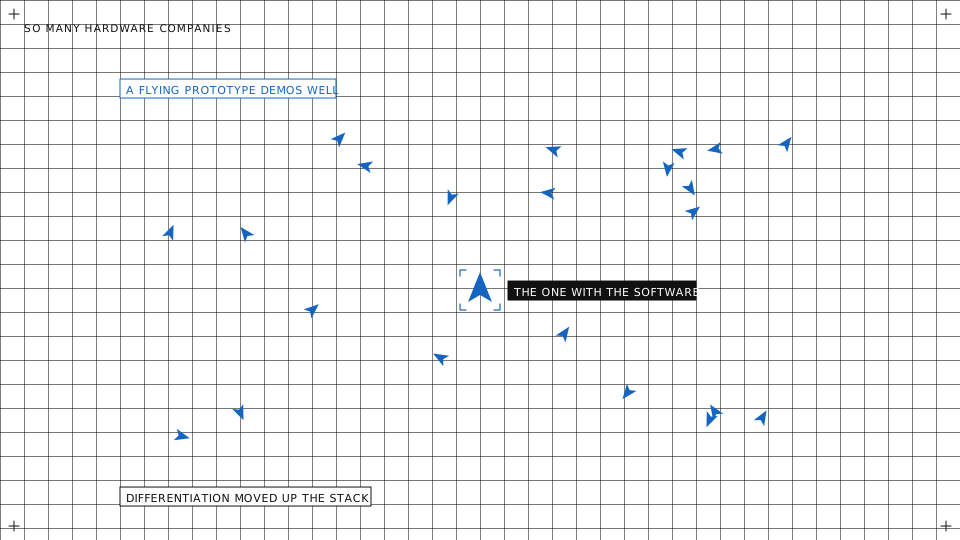
The drone market is crowded with hardware companies. Every region has its airframe builders; every year brings more. Why does everyone build hardware, and what does that mean for where the industry is going?
A flying prototype demos well
Hardware is the visible, fundable part of the industry. A machine in the air is a better pitch than a dashboard, and investors and grant committees respond to things they can watch fly. A new airframe is also a satisfying thing to build: the feedback is immediate, the physics is honest, and the first hover is a day everyone remembers.
The fragmentation is real
To be fair to the builders: requirements genuinely fragment the market. Payload, endurance, environment and certification produce legitimately different aircraft. A sprayer, an inspection quad, a mapping VTOL, a tethered mast and a heavy-lift hexacopter share little beyond the autopilot. Design by requirement is why drone manufacturers exist in such variety, and a customer with a real requirement is right to want the airframe that meets it.
But the differentiation moved
Motors, autopilots and sensors have commoditised. The open autopilots fly anything; the same motor and ESC vendors supply everyone; the cameras come from a handful of makers. Two airframes from different companies now differ less in flight than in what surrounds them.
What separates a sustainable drone business from a short-lived one is increasingly the software, the data products and the operational reliability around the airframe: whether the fleet can be run by a small team, whether the logs are kept and read, whether a customer’s health question about a specific battery has an answer, whether the aircraft fits the customer’s operation or demands its own.
The consequence
Many hardware companies, few sustainable ones, and value consolidating in the software and operations layer that any of them can build on. The manufacturer who ships an aircraft with no operational software leaves the hardest part to the customer; the one who writes a fleet platform from scratch spends two years not building aircraft.
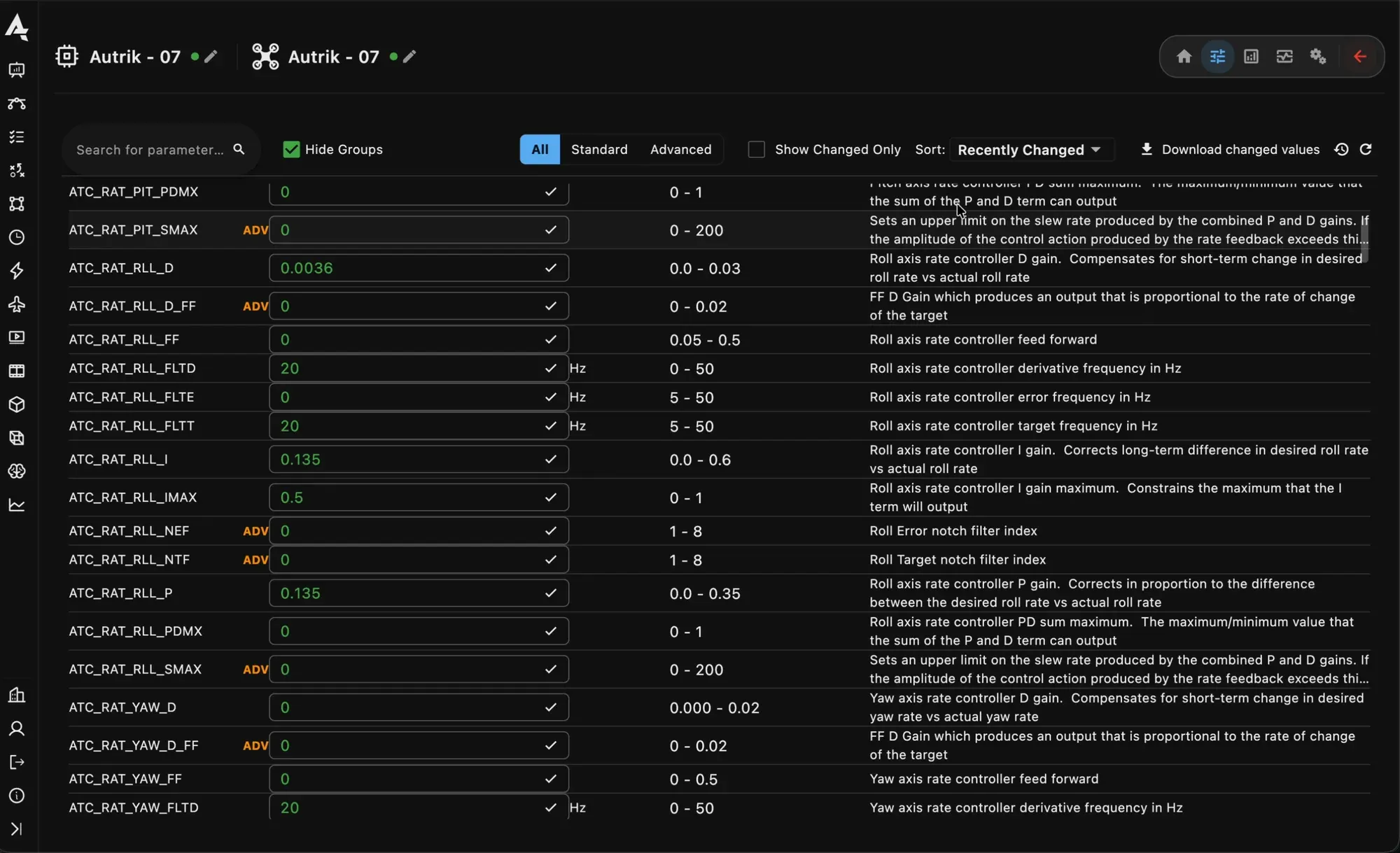
The parameters of one aircraft in the console, with their ranges and descriptions.
Where we stand
We are deliberately not another airframe company. We make hardware companies better instead of competing with them: the onboard client that runs on their companion computer, the fleet console their customers fly from, the data pipeline, the health twin that tells them which component wears first. The parts every airframe needs and few teams want to build twice. That is the building-blocks mission.
For a manufacturer it also means something during development: every test flight logged to one place, every parameter change recorded with who made it, and the noisy IMU or the GNSS that fails next to the USB hub found in the data rather than remembered by the test pilot.
Building an aircraft and wondering about the software half? We should talk. The counter-argument that hardware is still hard is in Hardware Is Hard, Really?.