



· Yogesh Khedar· Engineering· 4 min read
Drones Are Not Rocket Science — But They Are Still Hard
Space is one perfect shot with no second attempt. Drones are a thousand imperfect flights in dirty air. The hardness is different — not smaller.
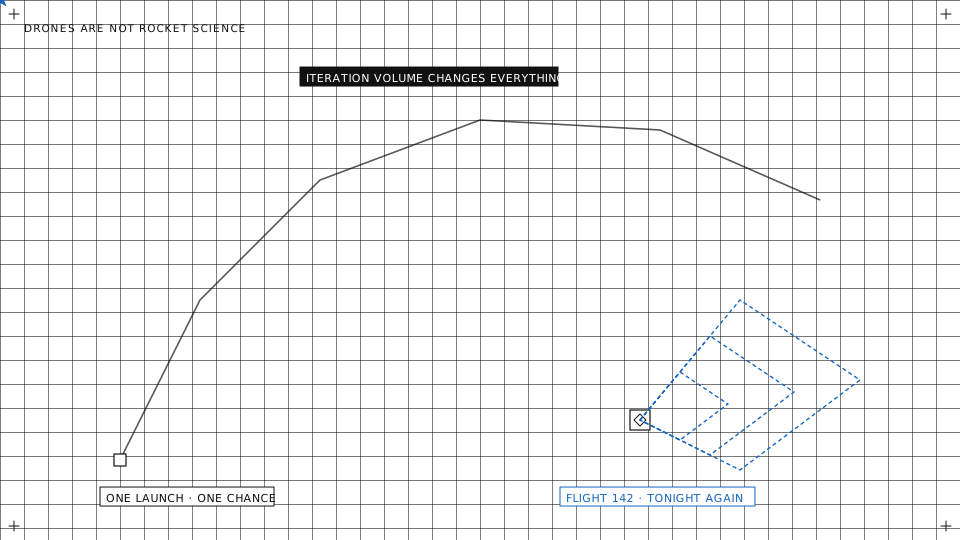
Having built for both, we can settle the joke honestly: no, drones are not rocket science. They are a different kind of hard, and dismissing that difference is how drone programmes fail.
What they share
Unforgiving physics. A launch vehicle and a 25 kg multirotor both live on margins: mass, power, thermal, structural. Add a sensor and something else has to give.
Deep systems integration. In both worlds the subsystem you neglected is the one that ends the mission. A loose connector, a resonance nobody characterised, a firmware default nobody read. The failure is rarely in the clever part.
A failure-analysis culture, or the lack of one. Space programmes investigate every anomaly to its root and feed the lesson back into design and process. The best drone teams do the same; most do not, and the gap shows in their logs.
Where space is harder
One shot. A launch or a planetary landing offers no second attempt, no recovery and no honest way to test the real thing end to end beforehand. Every test is a partial test, and the integration of partial tests is itself a discipline.
No atmosphere to help, or to hinder. Thermal control without convection, radiation on electronics, propellant behaviour in microgravity. The environment is simpler to describe and far harder to live in.
The navigation problems are extreme cousins of drone problems. Landing on a body without GPS is relative navigation with planetary stakes: anchor to a known point, track your own motion, trust your sensors. It is the same pattern we use in GPS-denied flight, with a budget of one attempt.
Where drones are harder than people think
Everything that space avoids by being empty.
- Dirty, changing environments. Rain, dust, birds, a crane that was not there last week, a Wi-Fi access point on the roof that now sits in the control link’s band.
- Weather. Not as a constraint on a launch window, but as a daily operational variable that decides whether the mission flies at all.
- GPS that comes and goes. Urban canyons, under structures, the occasional jammer. The navigation stack has to degrade gracefully, not fail.
- Cost pressure. The customer compares the drone against a person with a ladder, not against a launch.
- Volume. This is the one that matters most. A space mission is one perfect flight. A drone programme is a thousand imperfect ones, every week, with customers watching. Reliability at that cadence is a different discipline from reliability for a single launch.
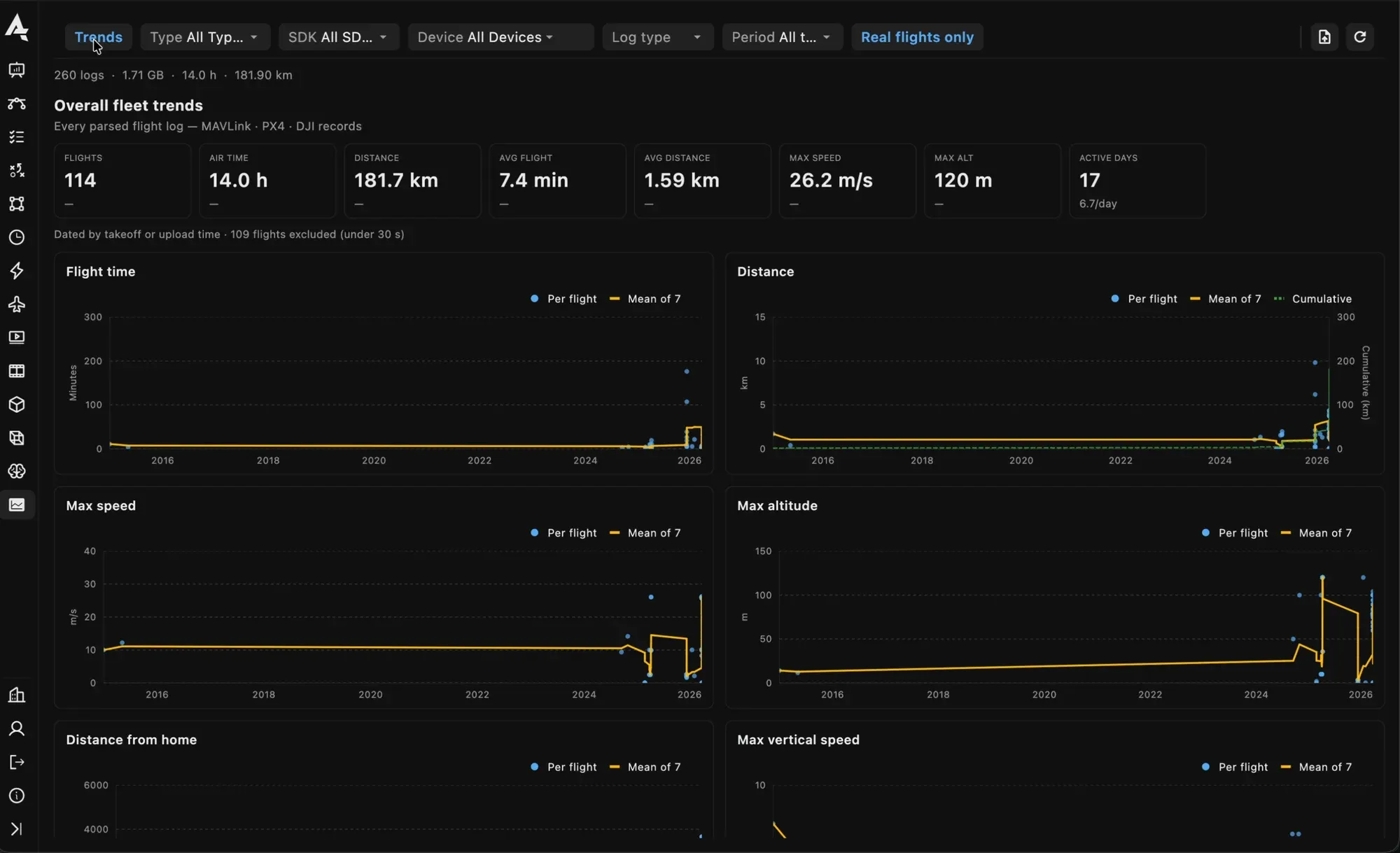
Fleet trends: every flight’s figures across the fleet, the mean of the last seven drawn through them.
Iteration volume changes everything
The thousand-flight reality is not a burden. It is the advantage, if the learning loop exists.
Every flight leaves a log. Every log carries the precursors of the next failure: a motor drawing more current than its siblings, a pack sagging a little further at take-off, a compass that disagrees with the IMU a little more each week. A space programme would give a great deal for that much data from the real vehicle. A drone programme has it and usually throws it away on landing.
Keeping it is what fleet-grade tooling means. In AutrikOS every flight’s log leaves the aircraft by itself, is reduced to per-component health figures, and is judged against that component’s own history and the limits its maker publishes, every night, for every aircraft in the fleet. Anomalies get caught before they become crashes, and a lesson learned on one airframe propagates to the whole fleet.
That loop is the thing space taught us to want and drones finally make affordable.
From one of us who made the journey: From Rocket Science to Drone Tech.