



· Yogesh Khedar· Engineering· 3 min read
Why Software-Defined Radio Is Hard
SDR promises any waveform, any band, just software. The physics, the real-time constraints and the regulator all have other plans.
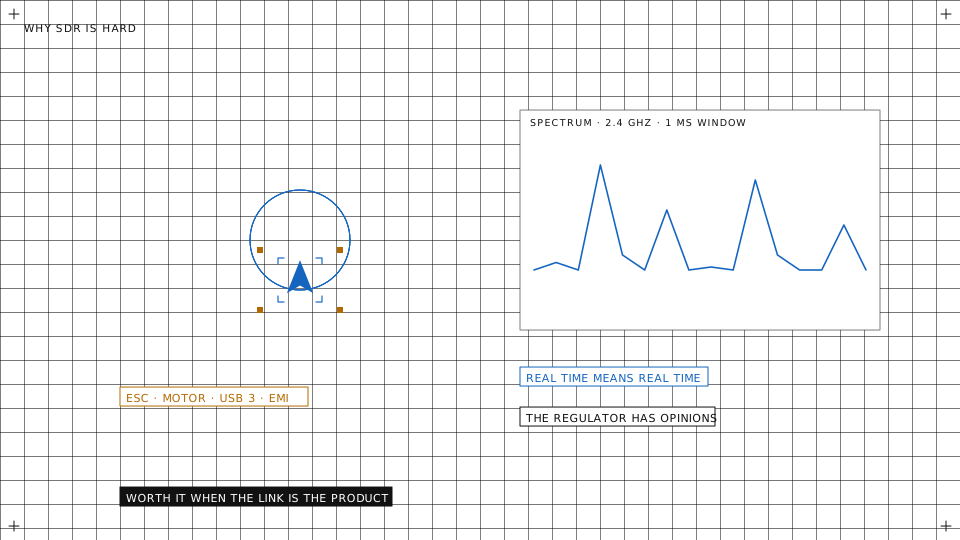
Software-defined radio carries a seductive promise: any waveform, any band, just software. Having spent real time with drone communication links, we can report that the promise survives contact with exactly none of the following.
Physics does not read your code
The software only sees what the RF front end hands it. Antenna placement and pattern, filtering, amplifier linearity and noise figure decide the link budget before the first sample reaches a processor. An antenna mounted next to a carbon arm has a pattern with a hole in it, and no firmware update moves the arm.
Everything in the chain is a compromise. A wider receive band hears more interference. A sharper filter adds group delay. A more linear amplifier draws more current, which the aircraft has to carry. The flexibility SDR promises in software is bought with hardware that is, by design, good at nothing in particular.
Real time means real time
Radio signal processing has latency budgets measured in microseconds and a data rate that does not pause while the operating system schedules something else. That pushes the work into FPGAs, where iteration is slow and talent is scarce, or into carefully pinned CPU cores where a missed buffer is a dropped frame.
The flexibility that makes SDR attractive is precisely what makes it hard to make fast. A fixed-function radio chip does one modulation very well; the software radio does any modulation, and every one of them has to be made to run on time.
The regulator has opinions
Transmitting is a licensed activity. Every waveform and band combination the software can produce is something a certification body may want tested, and spectrum law does not care that it is a configuration flag. A radio that can hop anywhere is a radio that has to prove it will not, and the proof is paperwork, measurement and time.
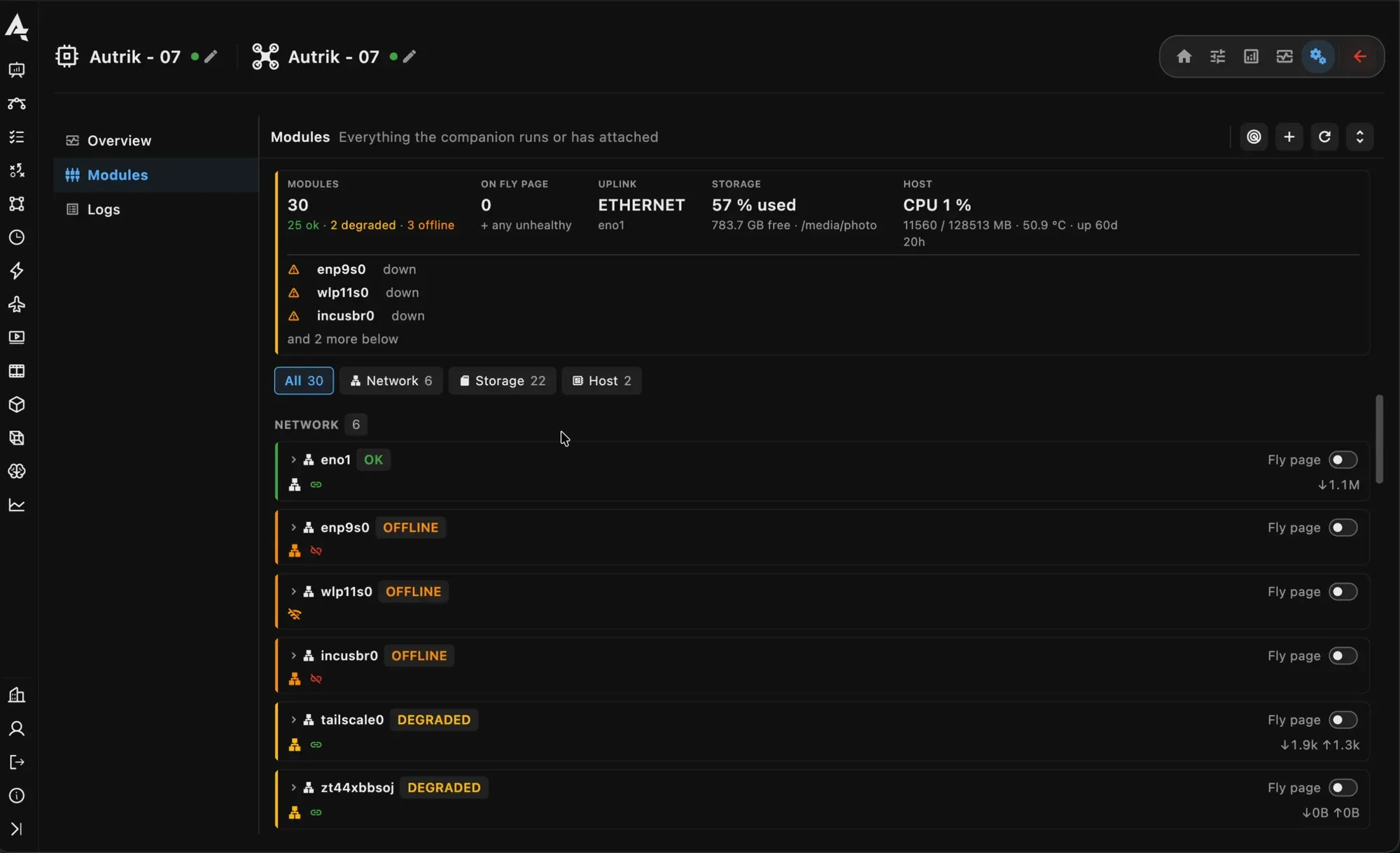
Each link’s state on the companion computer: the degraded one shows as degraded.
On a drone, add EMI
Integration on an aircraft is its own discipline. Transmitters sit centimetres from GNSS receivers and compasses. Switching ESCs radiate across the band. A USB 3 hub wipes out the satellites, which is a rite of passage for every drone manufacturer, and a self-made radio adds its own spurs to the mix. Power and weight budgets do the rest: the SDR board that was fine on the bench is the one that costs five minutes of flight time.
The console sees the result, not the cause: a link whose quality drops when the motors spin up, a GNSS fix that degrades when the radio keys. The onboard client’s module view shows each link’s state, and the health figures from each flight show the link quality trend over weeks, which is how the EMI problem gets found, by its symptom, long after it was designed in.
When it is worth it anyway
SDR earns its complexity when you genuinely need waveform agility: contested spectrum, a custom link with properties no product offers, research into the link itself, or a mesh between many aircraft that no commercial radio supports. For those, the hardness is the price of the capability, and worth paying.
For most operations, well-integrated commercial radios and LTE or 5G with proper encryption on top win on cost, certification and time to field. The honest answer to “should we build our own radio” is usually no, and the honest answer to “should we understand the one we bought” is always yes.
Building or choosing a link for an aircraft? Talk to us, and read how the layers above the radio are protected in What Does Cybersecure Actually Mean.